 Public Digital Domain
Under construction
Public Digital Domain
Under construction
Public Digital Domain
Under construction
Public Digital Domain
Under construction
Your browsing data built the world. Now it can build yours.
Sell it. Share it. Keep it.
For a person
Envoy collects your browsing record as you go, and it is held in your name. Nothing leaves your account until you send it. From there you have three things you can do with it, and doing nothing at all is a fourth.
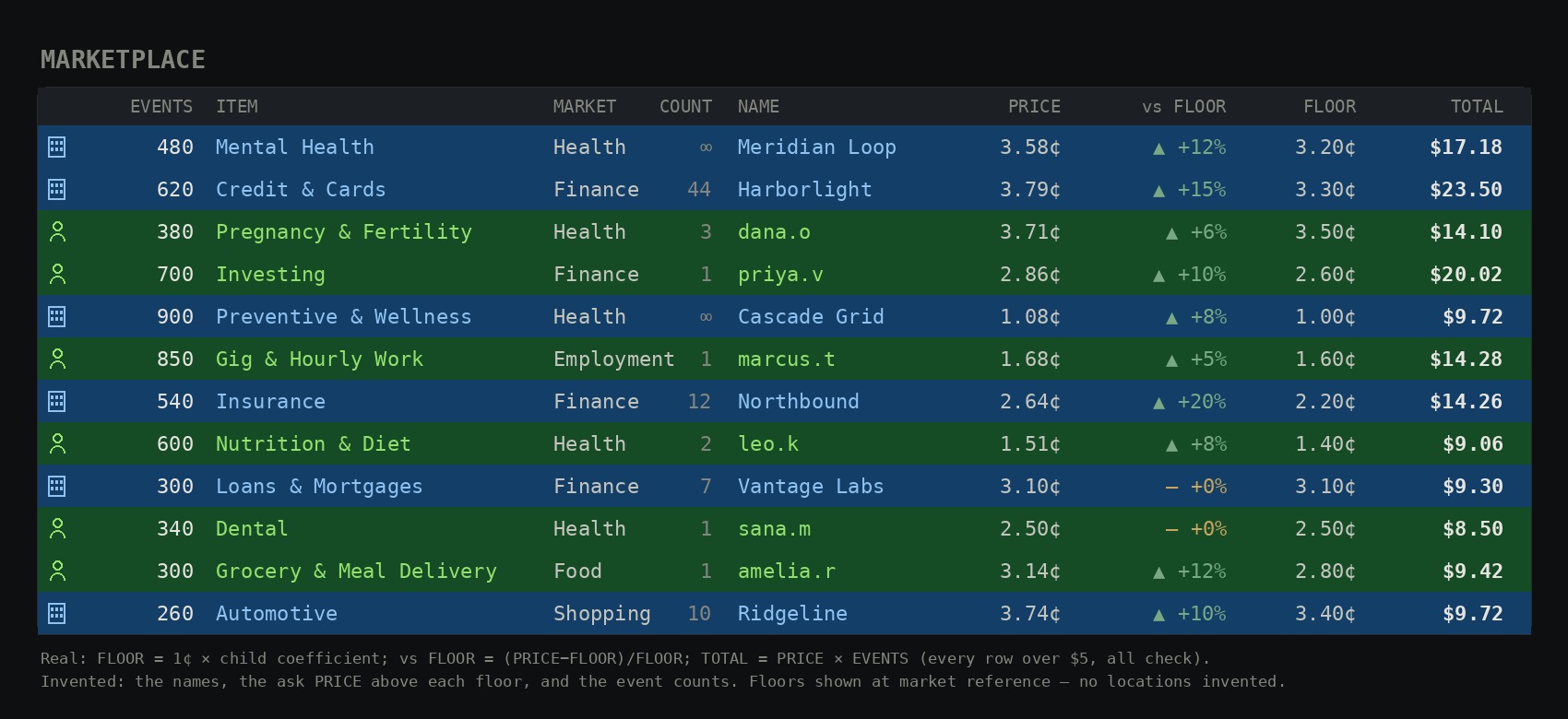
List a slice on the marketplace and set your own terms. Organizations buy it first-hand, from you, at a price that sits against a floor the market sets. You keep 60% of what a contract clears, and that 60 is of the gross.
Join a study with a code from the research team and send that study your data on the schedule it sets, de-identified. Unpaid, outside the market, and you can withdraw whenever you like.
Hand what you do online to a nonprofit or a public-interest cause. The same control as a sale, without a price or a transaction.
Withhold anything, block any buyer, or leave all of it exactly where it is. Silence is the default, and choosing it costs you nothing.
The marketplace board.
For a business
This is an arm's length market. You post what you are looking for, people decide whether to sell it to you, and the sale is a contract between the two of you that PDD clears and enforces. No broker sits in the middle holding a copy.
Say who you are and what the data is for. Declaration is the only path to cleared use, and the obligations you name in it bind you once it clears.
Post what you need. People whose records match decide for themselves whether to answer, and any of them can block you.
Every offer carries its price against the market floor, so you can see what you are paying and why before you commit to it.
Data is delivered once and kept for a use term of 12, 24, or 36 months, 24 by default. At term end you delete it and confirm the deletion through PDD. A model trained during the term may be kept. The raw data may not.
For research
Recruit participants who agreed to take part, and receive their data on a schedule you set. Nothing here is bought. Participation is unpaid and sits outside the market entirely, which is the point.
Post on the panel, or hand out a study code. Before anyone joins they see who runs the study, the institution behind it, which sites it covers, and what kinds of activity it collects.
Deliveries arrive de-identified, with page addresses and titles stripped out. PDD records that a delivery happened, not what was in it.
A participant can leave at any time, which stops every future delivery. What has already been delivered stays with the study.
Getting started
Limitations
Every system has an edge. These are ours, stated plainly rather than left for you to discover.
No surprises
A person
Sell
Share
Keep
Delete
A business
Buy
Keep
Delete
Research
Recruit
Receive
Delete
Where people meet business and research.